

Give Claude, Pi or Codex a seat on the team.
In your issue tracker, source control and team chat as one coworker.
- Now Private beta A small group of teams.
- Next Open beta Anyone can sign up. Teams that requested access go first, in order.
- Later General availability Stable release for every team.
- GitHub
- GitLab
- Bitbucket
- Jira
- Linear
- Slack
- Microsoft Teams
- Discord
- Notion
- Confluence
- Miro
The agent your team already tuned is now part of the team.
Each project picks its harness, Claude Code, Pi, Codex or OpenCode, with the provider and model you want.
With1 runs it the way it runs on a developer's laptop.
CLAUDE.md, AGENTS.md, skills, prompt templates, MCP servers, plugins: whatever
your repository holds is what runs.
Teams that want tighter control switch a project to strict mode. The platform's settings win and the repository's configuration is ignored.
- CLAUDE.md
- AGENTS.md
- .claude/skills/ 4 skills
- .mcp.json 2 servers
- .pi/extensions/ 1 extension
- Harness Claude Code
- Provider Anthropic (your key)
- Model claude-fable-5-1
- Trust mode Repository Strict
From ticket to merged pull request, in three steps.
Hand over a ticket, or just ask
Tell @with1 to start work on a ticket. The agent automatically reads the ticket description, comments, attached files and linked PRs to gain perfect context.
It works like a developer
A fresh VM boots for the session with your repository. It plans, codes, runs tests and pushes to a branch of its own.
Refine & Merge
With1 opens a pull request and asks for review. Review comments, failed checks and follow-up requests are automatically addressed.
One identity in every tool. Address it like a colleague.
The team talks to one colleague, the With1AI app in your code host, chat and issue tracker. Every task gets a thread in your team chat: the start, the pull request, the questions With1 asks and the merge, all in one place.
Review comments addressed to With1, requested changes and failed checks continue the task. When policy or judgement calls for a person, With1 asks, and the answer can come from the thread, the ticket or the app.
Standing rules in plain language work too. Tell it “when a ticket I handed over is done, send me a direct message” and it confirms what it stored and does it every time.
Every model call on your own key, metered and capped.
Your organization stores its own provider keys, Anthropic, OpenRouter, OpenAI, you name it. Key is never exposed to the agent.
There is no subscription in the middle and no markup on tokens.
Each request passes the gateway, is priced from the provider's catalogue and recorded against the session, the task and the organization. You set the limits: cost, time and turns per session, a monthly cap for the organization, and how many workers run at once.
- PAY-284 Retry queue backoff $6.80
- PAY-291 Webhook signatures $3.15
- WEB-77 Flaky checkout test $1.92
A fresh VM per session.
No credentials inside it.
Every session runs in a fresh Firecracker microVM, ready in under a second, with the harness you chose. An agent can be poisoned by what it reads: a dependency, a web page, a comment on a ticket. None of it can reach a developer's laptop, and when a session breaks its own machine, the next one starts clean.
No real keys
The VM holds two short-lived tokens made for it. It never holds a code-host token, a chat token or a model key.
Git through a gateway
The harness runs ordinary git. The gateway confines pushes to the task’s own branch with a special token.
Tools through a gateway
Every comment, pull request, ticket change and chat post is checked against your policy before it is performed under the With1 identity.
Policy and approvals
Your policy says what With1 may do unasked, what needs a named human’s approval, and what it may not touch at all. If you don’t want it creating tickets, turn that off.
Egress you allow
Open internet or an allow list per organization or project: hosts, address ranges, package registries. A blocked site can be granted for one task by a human.
Every action on record
Each external action is recorded with the task and session that caused it. Stop, restart or cancel any task, and download the full session for closed inspection.
Ask it anything about the code. Nobody gets interrupted.
A question to With1 in chat gets an answer in seconds, from what it knows about your repositories, your open tasks and your knowledge base. “How is PAY-284 going?” is answered from the task record, so a manager gets status without pulling a developer off their work.
When the answer needs the code, “do we have an index on the email column?”, With1 runs a read-only session on the current default branch and replies in the same thread. No branch, no commits, no ticket.
It remembers, too. Conventions and decisions per organization and per repository go into every session as files your harness reads natively. Tell it “always add tests” or “I prefer short PR descriptions” and it keeps that, for you, from whichever tool you ask in.
- Mira
@With1 do we have an index on the email column in users?
- With1
Yes. users_email_idx, unique, added in migration 0042. Read-only check on main, no changes made.
- Mira
how's PAY-284 going?
- With1
Pull request #291 is open, waiting on Jane's review since 10:20. Cost so far $6.80.
Designed for how you work.
Bugs, dependency upgrades, test coverage and refactors with a clear acceptance criterion. Review the pull request like any other.
Hand over several tickets and they run in parallel, up to the limit you set. A review on the first is picked up by whichever worker is free.
With1 runs the harness and configuration your repository already has, so it codes the way your team does.

Push code forward
while you commute.
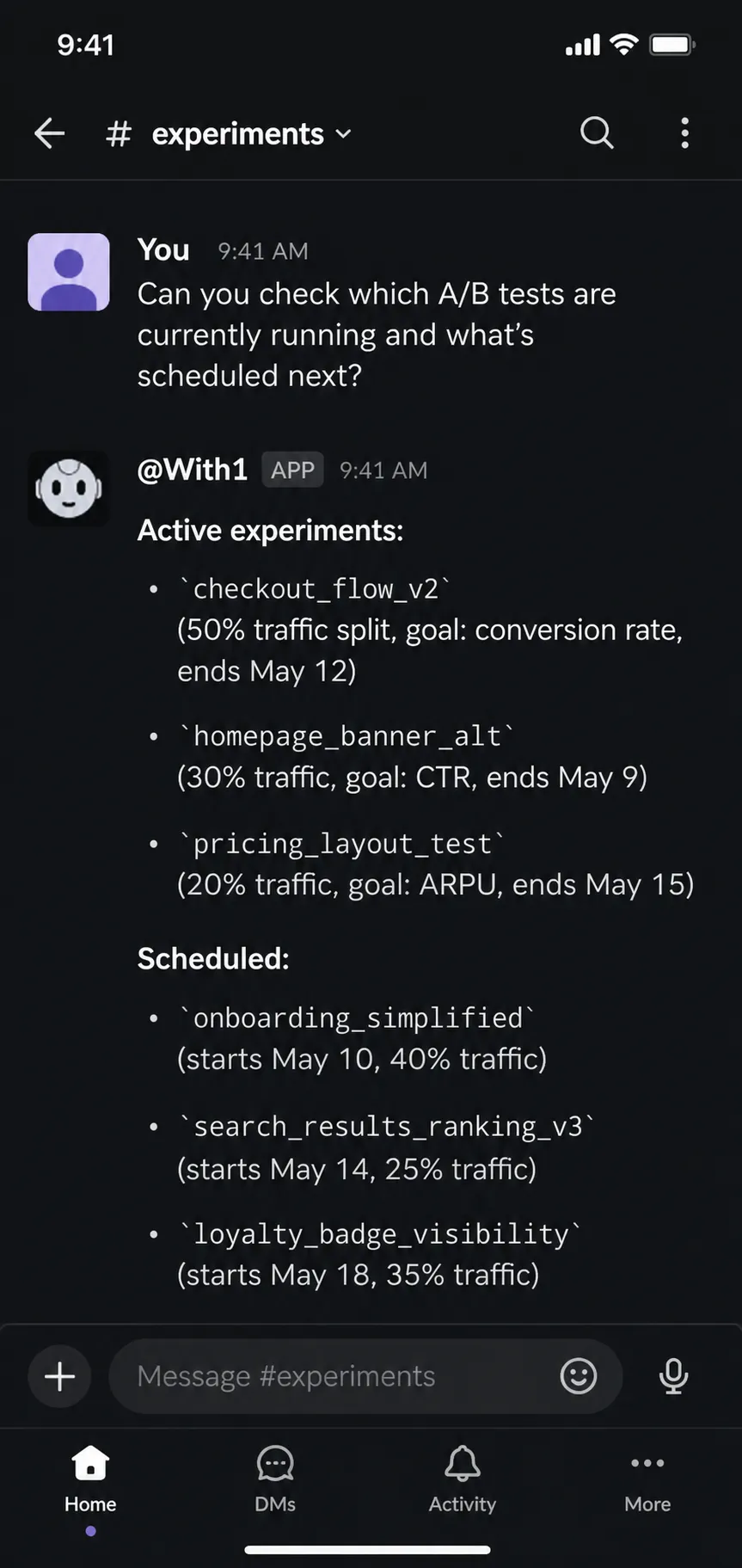
With1 lives in your tools, so it is already in the mobile apps you have. Hand over a ticket from your tracker's app, answer With1's question from your chat app, and review the pull request from your code host's app.
Nothing new to install. The thread for each task is where it always was, and so is With1.
Give your agent a seat on the team.
With1AI is in private beta with a small group of teams. Request access and we will set your organization up.